
 ASP.NET
HTML5中postMessage实现跨域的代码分析
对于使用H5实现跨域,很多人都一直处于半懂状态。知道使用postMessage发送消息,使用onMessage接受消息,但是到底哪个方法应该用window调用哪个应该用iframe的contentWindow调用不是很清楚。下面是我做的一个本地实现跨域的小demo,可以在github下载这个示例。为了执行它,首先,你需要找到你电脑的hosts文件,在127.0.0.1 localhost下添加如下代码:
127.0.0.1 localhost 127.0.0.1 main.com 127.0.0.1 A.com 127.0.0.1 B.com然后,你需要启动一个服务器,如Apache等,把github上下载的三个html文件放到你的服务器上。最后,你只需访问:你的端口号 ,就可以进行跨域通信了。
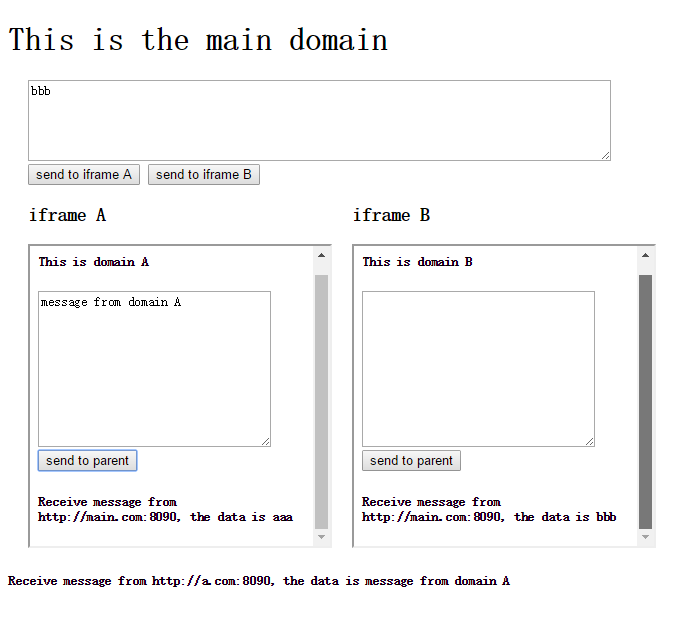
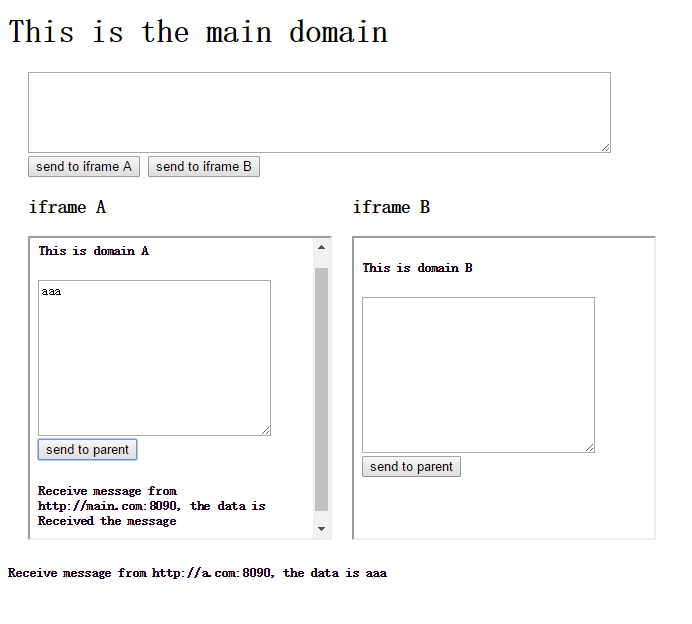
三个html文件的关系如下:三个域::8090 ; :8090 ; :8090 。 主页面maindomain.html在main.com,两个iframe (subAdomain.html , subBdomain.html)分别在 a.com , b.com 。在maindomain.html中,向textarea中输入消息,点击send to iframe按钮,可以发送消息到指定iframe (subAdomain.html 或者subBdomain.html),在ifame中也可以发送消息到maindomain.html,同时,有一个收到ifame消息的回执信息。
这应该是很常见的场景,把网站公共的资源放到某子域,在其他子域需要访问该子域上的资源。实现的效果如下。
1、不带回执信息:
2、带回执信息:
基本知识
首先介绍onMessage事件中,event的一些属性,理解这些可以使你很容易读懂我的示例。
* data: 传入的数据
* origin: 发送消息的文档所在的域
* source: 发送消息的文档的window对象的代理
如果你想在子域X向子域Y发送消息,你需要,在子域X的html文件,获取Y的window对象(iframe的contentWindow),然后调用postMessage(message,
Y所在的域),同时,在子域Y的html文件中,监听window对象message事件(使用onMessage)就好。当然,你可以在onMessage中再次使用postMessage,向子域X发送一个回执信息。 我们时常混乱的是,在哪个域的window对象上调用postMessage。
代码
main.com
<h1>This is the main domain</h1> <div style="margin:0 20px;"> <textarea name="main" cols="80" rows="5"></textarea><br/> <input type="button" value="send to iframe A"/> <input type="button" value="send to iframe B"/> </div> <div style="float:left; margin:0 20px;"> <h3>iframe A</h3> <iframe src=https://www.ym97.com/"http:/a.com:8090/subAdomain.html" frameborder="1" style="width:300px; height:300px;"></iframe> </div> <div style="float:left;"> <h3>iframe B</h3> <iframe src=https://www.ym97.com/"http:/b.com:8090/subBdomain.html" frameborder="1" style="width:300px; height:300px;"></iframe> </div> <div style="float:left;"> <h5 id="received"></h5> </div> <script> var received = document.querySelector('#received'); var sendToIframeA = document.querySelectorAll('input')[0]; var sendToIframeB = document.querySelectorAll('input')[1]; var iframeA = document.querySelectorAll('iframe')[0]; var iframeB = document.querySelectorAll('iframe')[1]; //receive message function getMessage(e){ console.log('main received!'); received.innerHTML = 'Receive message from ' + e.origin + ', the data is ' + e.data; e.source.postMessage('Received the message', e.origin); } window.addEventListener('message', getMessage, false); //post message sendToIframeA.addEventListener('click', function(){ var content = document.querySelector('textarea').value; iframeA.contentWindow.postMessage(content, ':8090'); }, false); sendToIframeB.addEventListener('click', function(){ var content = document.querySelector('textarea').value; iframeB.contentWindow.postMessage(content, ':8090'); }, false); </script>a.com
<h5>This is domain A</h5> <textarea name="subA" cols="30" rows="10"></textarea> <input type="button" value="send to parent"/> <div style="float:left;"> <h5 id="received"></h5> </div> <script> var send = document.querySelector('input'); var text = document.querySelector('textarea'); var received = document.querySelector('#received'); //receive message function getMessage(e){ console.log('A received!'); received.innerHTML = 'Receive message from ' + e.origin + ', the data is ' + e.data; //e.source.postMessage('Received the message', e.origin); } window.addEventListener('message', getMessage, false); //post message send.addEventListener('click', function(){ var content = text.value; window.parent.postMessage(content, ':8090'); }, false); </script>b.com
<h5>This is domain B</h5> <textarea name="subB" cols="30" rows="10"></textarea> <input type="button" value="send to parent"/> <div style="float:left;"> <h5 id="received"></h5> </div> <script> var send = document.querySelector('input'); var text = document.querySelector('textarea'); var received = document.querySelector('#received'); //receive message function getMessage(e){ console.log('B received!'); received.innerHTML = 'Receive message from ' + e.origin + ', the data is ' + e.data; //e.source.postMessage('Received the message', e.origin); } window.addEventListener('message', getMessage, false); //post message send.addEventListener('click', function(){ var content = text.value; window.parent.postMessage(content, ':8090'); }, false); </script>相关文章推荐:
以上就是HTML5中postMessage实现跨域的代码分析的详细内容,更多请关注聚合云库其它相关文章!
本站内容来源于网络,如有侵权请与我们联系,我们会及时删除,我们深感抱歉!
注:本站所有信息仅供用于网络技术学习参考,学习中请遵循相关法律法规!
本文地址: https://v30.fanwenzhu.com/jiaob/cssm/7258.shtml
相关文章
热门TAG
win10 ecshop 主机 阿里云 解决 配置 C# C++ 解析 SQL语句 命令 Go语言 方法 CSS3 HTML5 CSS win7 MSSQL 服务器配置 IIS7.5 IIS7 IIS6 IIS CentOS 7 Linux oracle数据库 oracle phpcms discuz discuz教程最新文章
-
 其中border-left决定了底部直
时间:2021-01-23
-
 当你自己回头来看你写的
时间:2021-01-23
-
 ④格式标签 粗体:b/b 斜
时间:2021-01-23
-
 我们直接看代码: !DOCTY
时间:2021-01-23
-
 这里就是吐槽的IE6!) 图
时间:2021-01-23
-
 假设我们的HTML代码如下:
时间:2021-01-23
-
 那么使用 CSS3 新增的选择
时间:2021-01-23
-
 scaleGlassRectangle.y
时间:2021-01-23
热门文章
-
 可以加我的HTML5前端交流群111645711 CSS源码
时间:2021-01-15
-
 就可以对子元素进行 3D 变形操作了
时间:2021-01-12
-
 用css让一个容器水平垂直
时间:2021-01-12
-
 而没有设置高度
时间:2021-01-19
-
 canvas与html5实现视频截图成果
时间:2021-01-19
-
 所以通常不需要发送
时间:2021-01-19
-
 我们尝试一下更新一下HTML结构
时间:2021-01-23
-
scaleGlassRectangle.y
时间:2021-01-23
-
 HTML5生拖放实例分析
时间:2021-01-12
-
 在全局:root{ }伪类中定义了一个 CSS 变量
时间:2021-01-21